AI in job interviews: the 2026 statistics.
How many candidates use AI, how many employers do, what each side worries about, and what the tools cost. Every figure is quoted from the organisation that measured it, with the link, the date and who was asked.
The short version
Each card is one figure, quoted from the organisation that measured it. Click a card for the exact words, the sample and the link.
The job hunt around the interview
More applications, more interviews per hire, and a lot of silence afterwards. This is the context the rest of the numbers sit in.
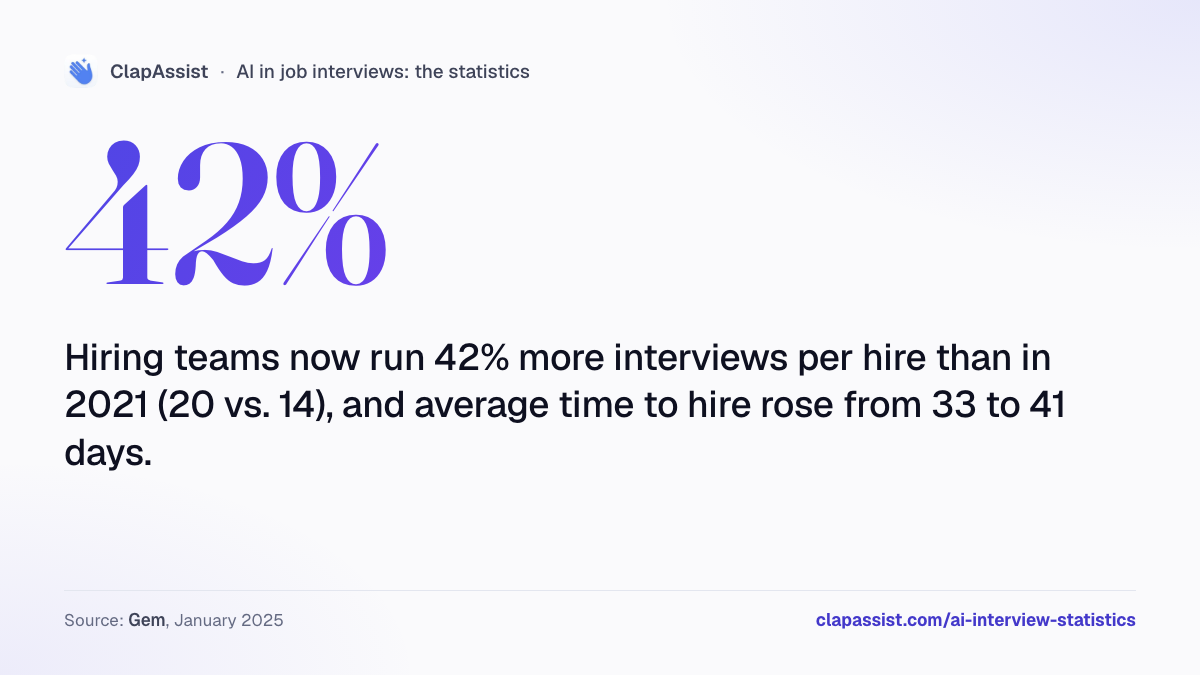
Hiring teams now run 42% more interviews per hire than in 2021 (20 vs. 14), and average time to hire rose from 33 to 41 days.
“Hiring teams conduct 42% more interviews per hire than in 2021 (20 vs. 14), contributing to a 24% increase in average time to hire (41 vs. 33 days).”
Keep in mind: Interviews per hire counts every interview held across all candidates for one filled job, not the rounds one person sits. Gem sells recruiting software.
Every hire on Ashby's platform required more than 300 applications on average throughout 2025, after applications per hire tripled from 2021 to 2024.
“Applications per Hire tripled from 2021 to 2024 and remain elevated today. Throughout 2025, every hire required more than 300 applications on average.”
Keep in mind: Ashby sells recruiting software; these are its customers' jobs.
Hired technical candidates took about 18 days to get through the full interview loop, from screen to final interview; business candidates took about 14.
“Interview structure varies meaningfully by job function, with hired technical candidates requiring more time (~18 days) to complete the full interview loop from screen to final interview. Hired business candidates take roughly 14 days from first to last interview.”
Keep in mind: Hired candidates only, and only the interview stage, not the time from application to offer.
U.S. applicants per open role on LinkedIn have doubled since the spring of 2022.
“LinkedIn data shows US applicants per open role have doubled since the spring of 2022.”
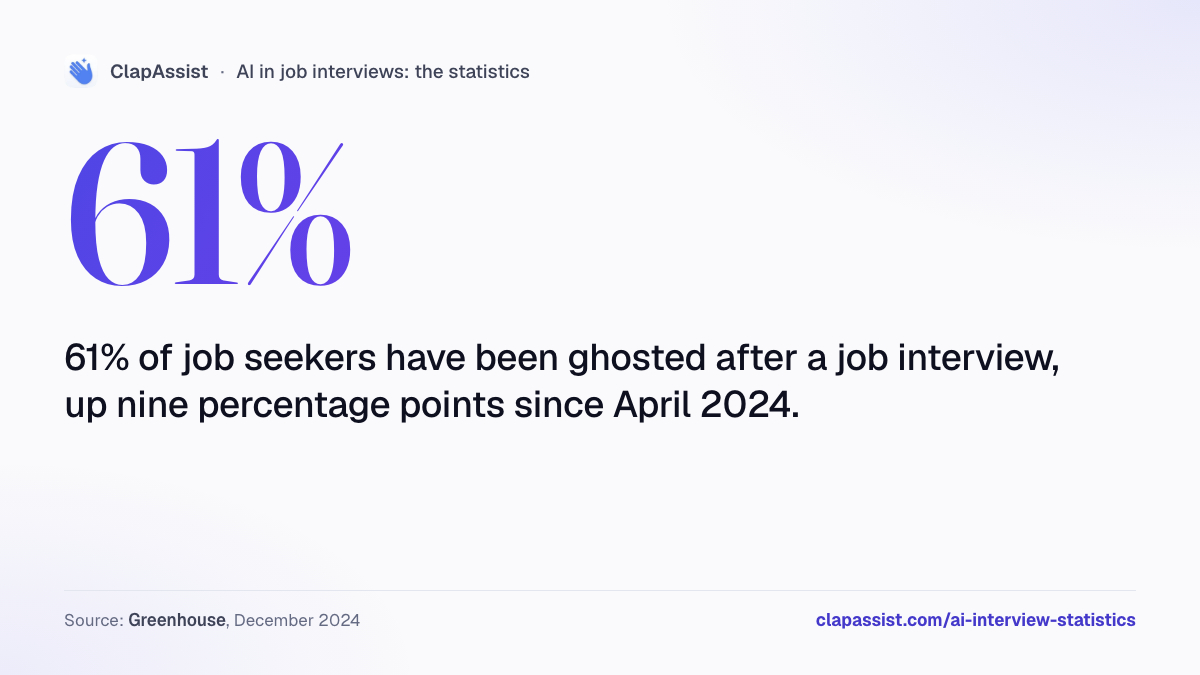
61% of job seekers have been ghosted after a job interview, up nine percentage points since April 2024.
“This disrespectful behavior is on the rise: 61% of job seekers have been ghosted after a job interview, a nine percentage point increase since April 2024.”
Keep in mind: Greenhouse sells hiring software.
56% of UK candidates report being ghosted after an interview, and 66% in Ireland.
“56% of UK candidates report being ghosted”
Keep in mind: Greenhouse sells hiring software.
It goes both ways: 41% of organizations say candidates are ghosting them during the interview process.
“While attempting to fill these roles, 51% of organizations report a low number of applicants, while 41% say they are seeing candidates "ghosting" the organization during the interview process.”
79% of workers surveyed admit they are feeling heightened anxiety in the current job market.
“The latest Greenhouse 2024 State of Job Hunting report – a survey of 2,500 workers across the US, UK and Germany – reveals nearly half of US workers are actively job-hunting, yet 79% admit they're feeling heightened anxiety in this current job market.”
Keep in mind: About the job market in general, not interview nerves. The page does not say whether the 79% covers all three countries or U.S. workers only.
How job seekers use AI
Most job seekers now use AI somewhere in the search. The surveys below differ in who they asked and where, so read the sample line under each figure before comparing them.
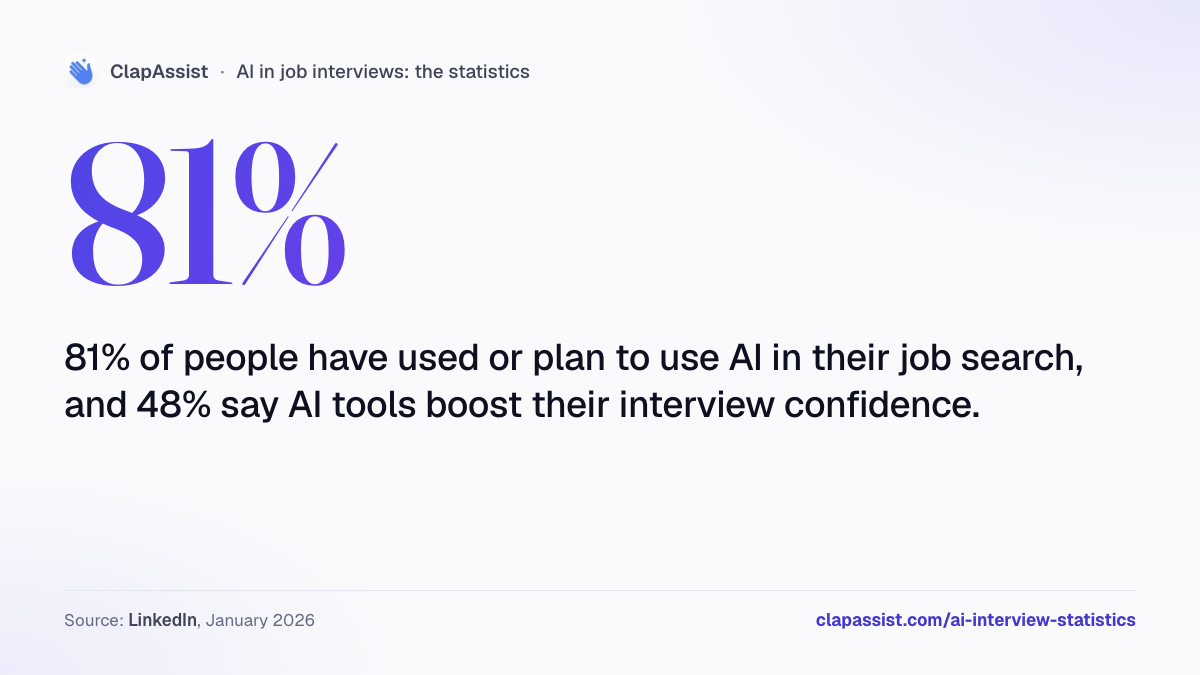
81% of people have used or plan to use AI in their job search, and 48% say AI tools boost their interview confidence.
“81% of people have or say they plan to use AI in their job search and nearly half (48%) say AI tools boost their interview confidence.”
Keep in mind: Counts people who plan to use AI as well as those who already do. LinkedIn sells hiring and job-search products.
58% of job seekers across 12 countries were using AI tools in their job search, and 83% of those users said they had used it to exaggerate or lie about their skills.
“Capterra’s Job Seeker AI Survey of nearly 3,000 job seekers from 12 different countries reveals that a majority (58%) are using AI tools to help them in their current job search.”
Keep in mind: The 83% is a share of AI users, not of all job seekers, and covers resumes, cover letters, applications and skills tests.
39% of job candidates said they used AI during the application process, most often to write résumé or CV text.
“A 4Q24 Gartner survey of 3,290 job candidates found that four in 10 candidates (39%) said they used AI during the application process.”
28% of job seekers had used AI to generate answers to interview questions.
“29% of job seekers have used AI to complete a test assignment or skills assessment, 28% have used AI to generate interview question answers, and 26% have used AI to mass apply to jobs.”
Keep in mind: The survey does not say whether the answers were prepared beforehand or used during the interview.
Indeed reports that 92% of candidates in India actively use AI tools, most often for interview preparation (42%) and CV optimisation (36%).
“A remarkable 92% of candidates actively use AI tools , for interview preparation (42%), CV optimisation (36%), and more.”
Keep in mind: Indeed does not publish the sample size or method behind this figure. Weigh it accordingly.
AI during the live interview
Using AI while the interview is happening is where opinions split. Here is what candidates say they do, what they think is fair, and what interviewers say they see.
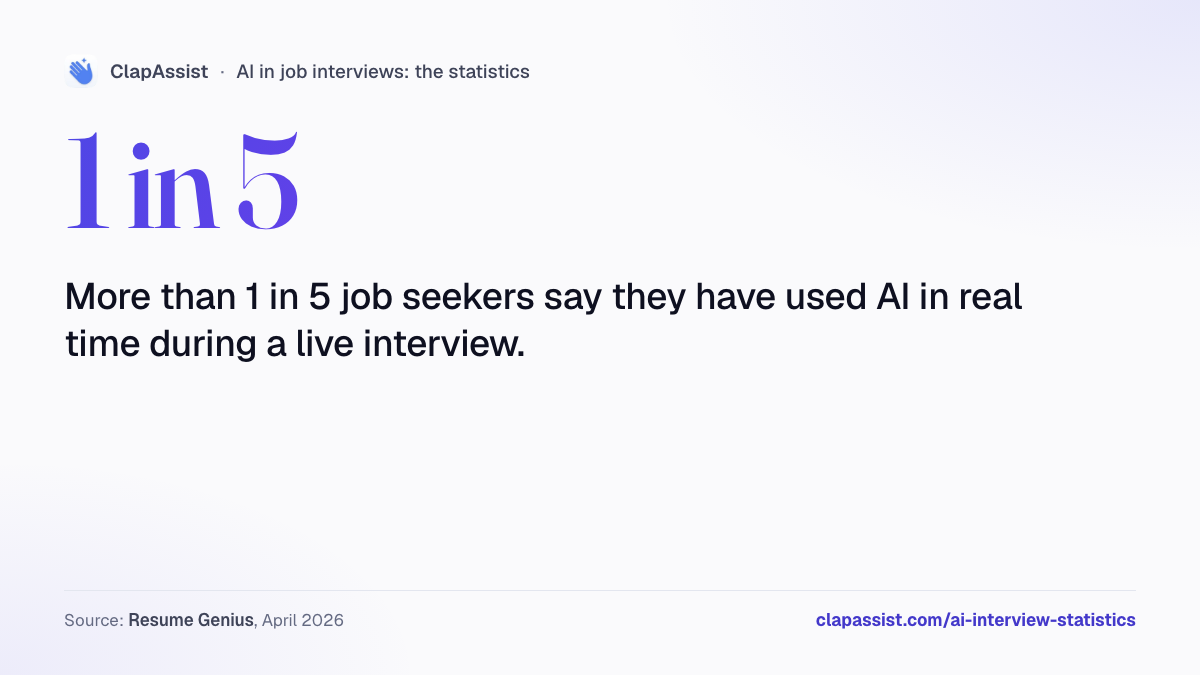
More than 1 in 5 job seekers say they have used AI in real time during a live interview.
“More than 1 in 5 job seekers say they’ve used AI in real time during a live interview, and nearly as many report using it to complete skills tests or assessments.”
Keep in mind: Resume Genius sells resume and career tools.
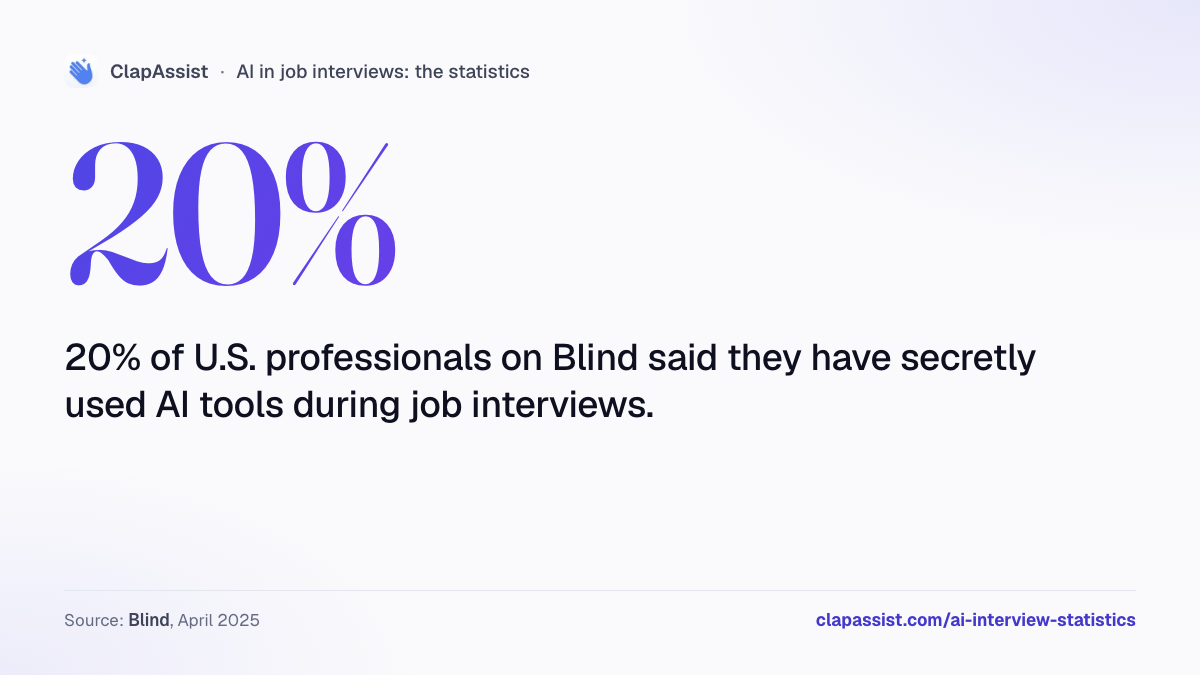
20% of U.S. professionals on Blind said they have secretly used AI tools during job interviews.
“Blind, an anonymous community app for professionals, found that 20% of U.S. professionals have secretly used AI tools during job interviews.”
Keep in mind: Blind's users lean toward technology jobs. The same survey found 55% agreed that using AI during interviews has become the new norm.
Only 19% of U.S. candidates say using AI in a live interview crosses the line.
“While 19% of US candidates say using AI in a live interview crosses the line, most don’t see it that way.”
Keep in mind: Greenhouse sells hiring software.
46% of U.S. hiring managers have seen interviewees use AI to answer interview questions.
“Nearly half (46%) have also encountered interviewees using AI to answer interview questions, while 34% have seen AI-generated LinkedIn or other social media profiles.”
Keep in mind: Resume Genius sells resume and career tools.
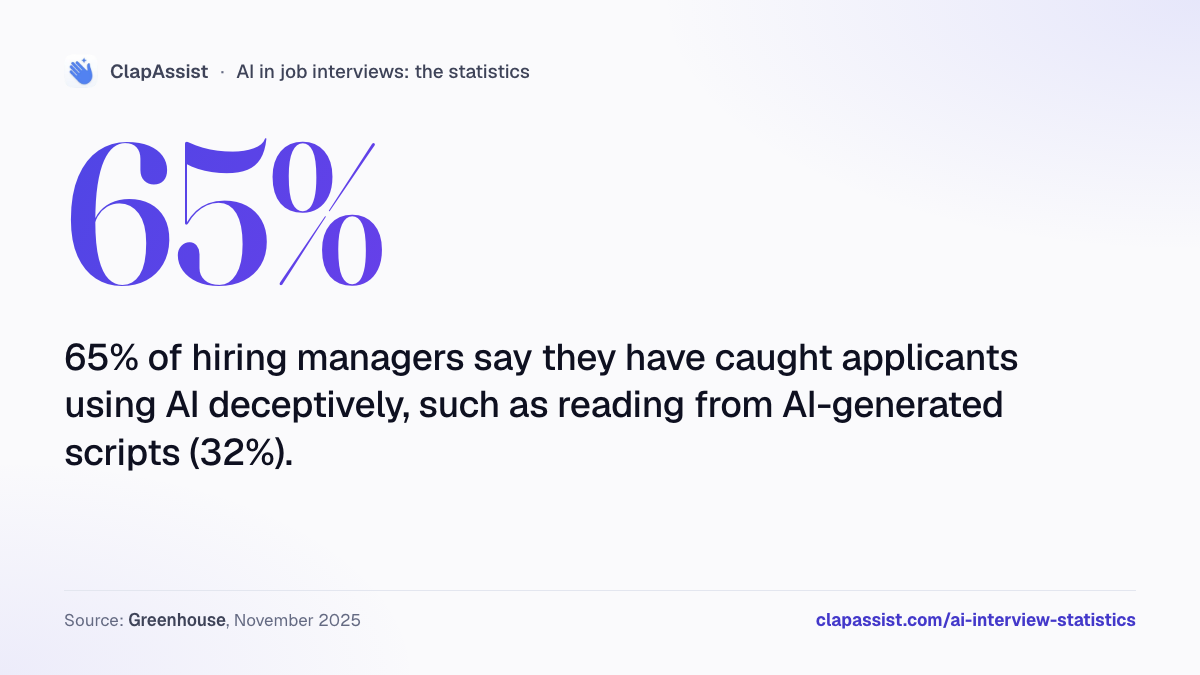
65% of hiring managers say they have caught applicants using AI deceptively, such as reading from AI-generated scripts (32%).
“Two in every three (65%) hiring managers have caught applicants using AI deceptively, like reading from AI-generated scripts (32%), hiding prompt injections in resumes (22%), or showing up as deepfakes (18%).”
Keep in mind: The figures describe what hiring managers have ever caught, not a share of candidates. Greenhouse sells hiring software, including an identity-check product.
81% of FAANG interviewers surveyed suspected candidates were using AI to cheat, and about a third said they had caught someone.
“About a third of FAANG interviewers said that they’ve actually caught someone cheating during an interview, and 81% said that they suspected that candidates are using AI to cheat.”
Keep in mind: A small, self-selected sample. The same survey found only 11% of FAANG interviewers said their companies use cheating-detection software.
When the interviewer is an AI
The other side uses AI too. More candidates now meet an AI interviewer, and many are not told when AI judges them.
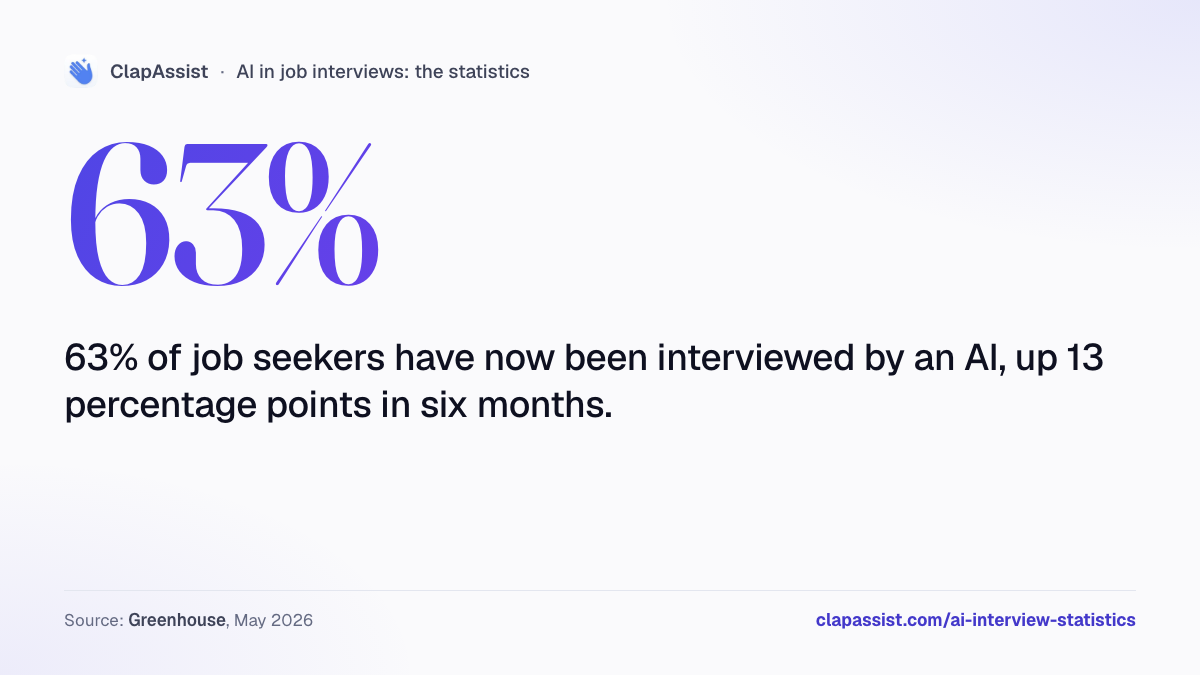
63% of job seekers have now been interviewed by an AI, up 13 percentage points in six months.
“Nearly two-thirds (63%) have now been interviewed by an AI, up 13 percentage points from six months ago, according to the Greenhouse 2026 Candidate AI Interview Report, which surveyed 2,950 active job seekers.”
Keep in mind: Greenhouse sells hiring software.
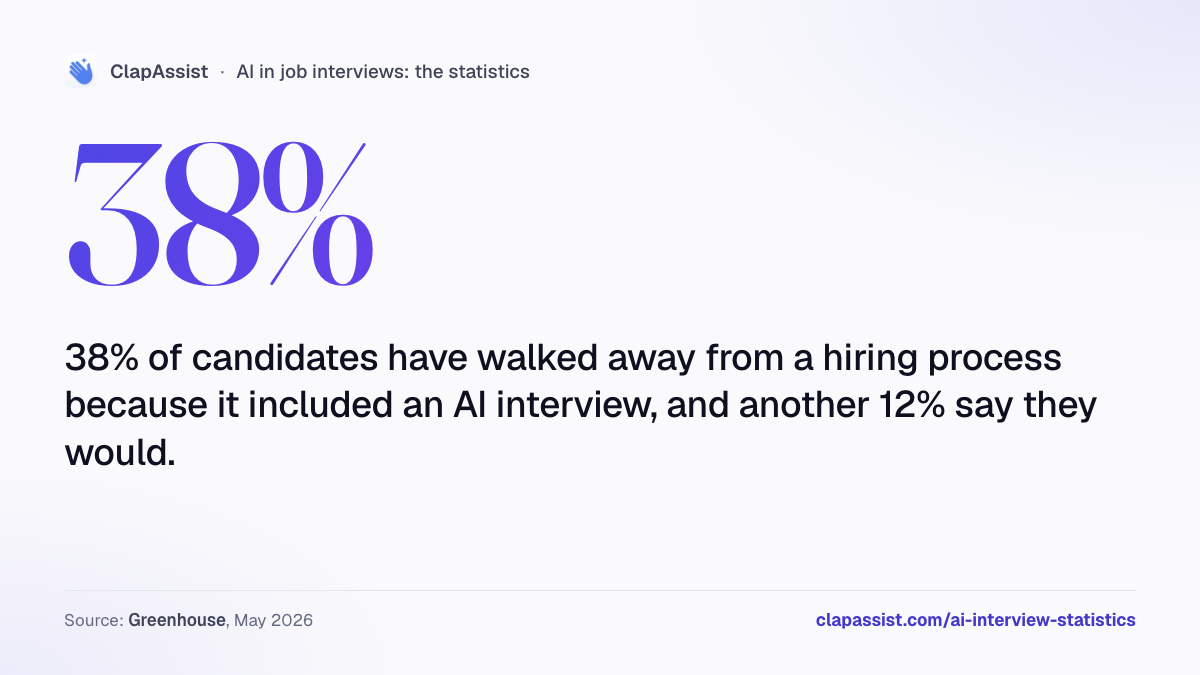
38% of candidates have walked away from a hiring process because it included an AI interview, and another 12% say they would.
“Yet 38% of candidates have walked away from a hiring process because it included an AI interview, and another 12% say they would.”
Keep in mind: Greenhouse sells hiring software.
Of candidates who completed an AI interview, 28% moved forward, 13% were formally rejected and 51% never heard back.
“Among those who completed an AI interview, 28% moved forward to the next round, while 13% were formally rejected, and 51% never heard back.”
Keep in mind: Greenhouse sells hiring software.
Given the choice in a field experiment, 80 percent of applicants for customer-service jobs chose a voice-AI interviewer over a human recruiter.
“What’s more, most applicants—80 percent—chose voice AI over a real person for their interview.”
Keep in mind: The 80 percent is among applicants who were offered the choice, not all 70,000. People still made the hiring decisions.
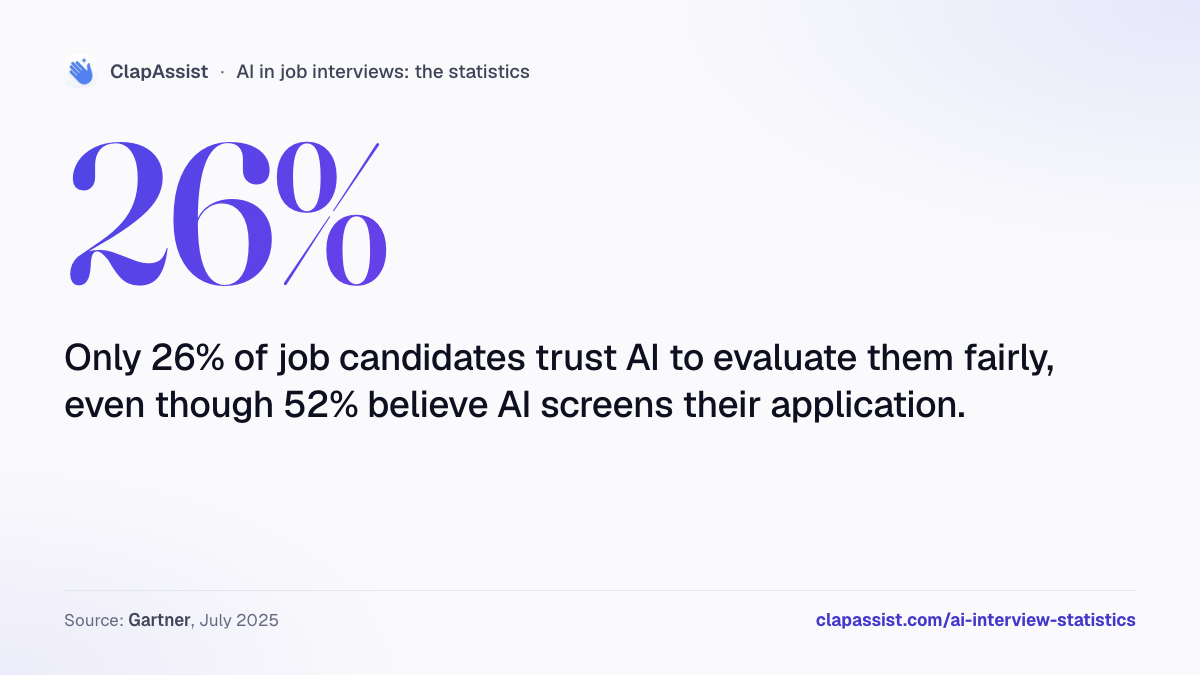
Only 26% of job candidates trust AI to evaluate them fairly, even though 52% believe AI screens their application.
“Only one-quarter (26%) of job candidates trust AI will fairly evaluate them, even though just over half of candidates (52%) believe AI screens their application information, according to a survey by Gartner, Inc.”
20% of U.S. hiring managers say AI is used to evaluate candidates at their company without any disclosure; only 35% say it is always disclosed.
“Adoption has outpaced transparency: only 35% of hiring managers say their company always discloses when AI is used to evaluate candidates, while 20% say AI is used without any disclosure.”
Keep in mind: Resume Genius sells resume and career tools.
How employers use AI in hiring
Recruiting is where employers use AI most among HR tasks, and most talent teams plan to use more of it.
27% of organizations apply AI in talent acquisition, more than in any other HR function.
“Recruiting stands out as the clear leader, with 27% of organizations applying AI in talent acquisition — more than any other HR function.”
Keep in mind: The same article says 39% of organizations use AI in their HR functions at all.
35% of newly hired U.S. workers met some form of AI in their interview process, up from 22% two quarters earlier.
“More than one in three newly hired workers (35%, up from 22% in Q4) encountered some form of AI during their interview journey, including AI-analyzed video interviews (15%, up from 7.0% in Q4), background AI transcription software (12%, up from 6.9% in Q4), and fully automated interview agents (7.7%, down slightly from 8.2% in Q4).”
Keep in mind: Includes AI-analyzed video interviews (15%), AI note-taking (12%) and fully automated interview agents (7.7%).
66% of recruiters plan to increase their use of AI for pre-screening interviews in 2026.
“Two-thirds of recruiters (66%) plan to increase their use of AI for pre-screening interviews in 2026, which 70% believe will help them have more valuable conversations with candidates.”
Keep in mind: A plan, not current use. LinkedIn sells AI recruiting tools.
84% of talent leaders plan to use AI in talent acquisition in 2026.
“AI is the big story—84% of talent leaders plan to use it next year, according to the report.”
Keep in mind: A plan for the coming year, published in October 2025.
Fake candidates and how employers respond
A separate problem from AI help: people who are not who they say they are. These figures are about identity fraud, and about the in-person checks employers are adding because of it.
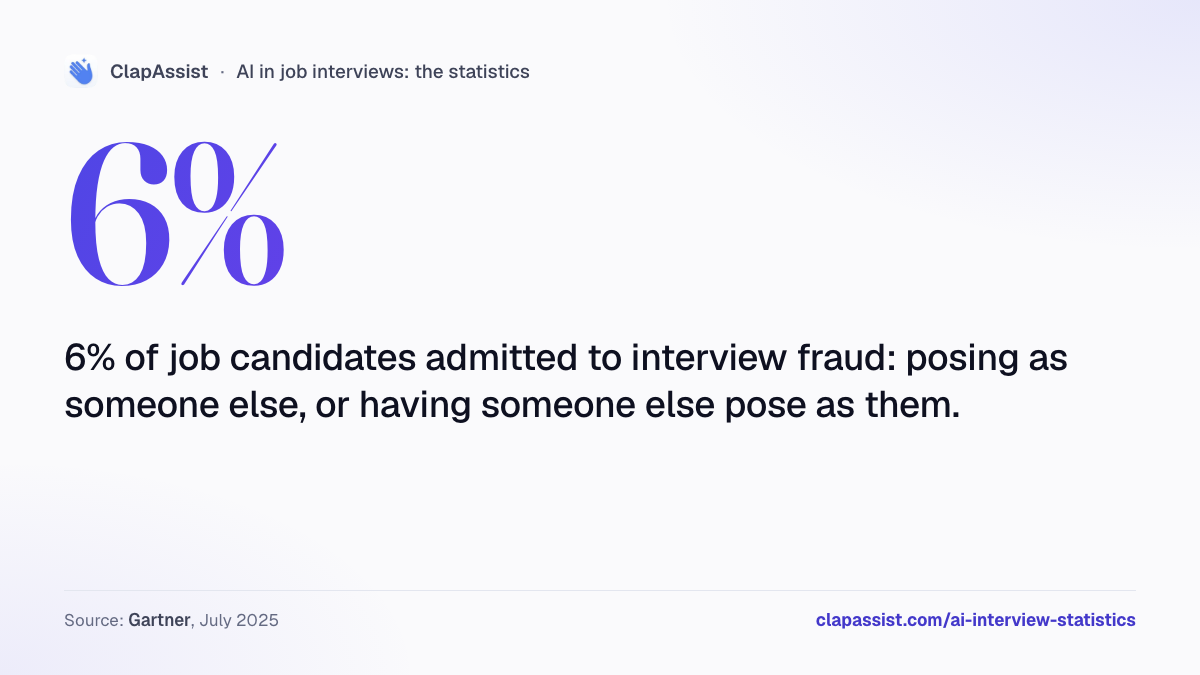
6% of job candidates admitted to interview fraud: posing as someone else, or having someone else pose as them.
“A 2Q25 Gartner survey of 3,000 job candidates found 6% admitted to participating in interview fraud — either posing as someone else or having someone else pose as them in an interview.”
Keep in mind: This is impersonation, not AI help.
Gartner predicts that by 2028, one in four candidate profiles worldwide will be fake.
“Gartner predicts that by 2028, one in four candidate profiles worldwide will be fake.”
Keep in mind: A forecast for 2028, not a measurement. Gartner's own wording elsewhere: profiles that contain material identity misrepresentation.
35% of U.S. hiring managers say someone other than the listed applicant has taken part in a virtual interview, and 31% have interviewed a candidate later found to be using a fake identity.
“31% have interviewed a candidate who was later revealed to be using a fake identity, while 35% say someone other than the listed applicant has participated in a virtual interview.”
Keep in mind: Checkr sells background and identity checks.
51% of U.S. hiring managers agree that AI has made it harder to trust what they see and hear in virtual interviews.
“When asked whether AI has made it harder to trust what they see and hear during virtual interviews, more than half (51%) of respondents agreed or strongly agreed.”
Keep in mind: Checkr sells background and identity checks.
36% of U.S. job seekers have used AI to alter their appearance, voice or background in video interviews; most of them (59%) did it to look more professional.
“Over a third of job seekers (36%) in the U.S. have used AI to alter their appearance, voice, or background during video interviews, with 59% doing so to appear more professional and 37% to hide physical appearance and identity traits.”
Keep in mind: Altering a background includes ordinary blur and touch-up filters. This is not a measure of deepfakes.
39% of U.S. hiring managers are conducting more in-person interviews to verify that candidates are authentic.
“To verify authenticity, 39% of hiring managers in the U.S. are conducting more in-person interviews, suggesting they’re trying to separate real talent from the fakes and spending more time doing so, not less.”
Keep in mind: Greenhouse sells hiring software, including an identity-check product.
Detected cheating and fraud attempts on CodeSignal's proctored assessments rose from 16 percent in 2024 to 35 percent in 2025.
“In 2025, cheating and fraud attempt rates for proctored assessments more than doubled, rising from 16 percent in 2024 to 35 percent.”
Keep in mind: Online skills tests, not live interviews. Counts attempts that were detected and flagged, including plagiarism and stand-in test takers, not AI use alone. CodeSignal sells the assessments and the detection.
One North Korean remote IT-worker scheme used 68 identities stolen from people in the U.S. and defrauded 309 U.S. businesses, according to the U.S. Department of Justice.
“The case involved one of the largest North Korean IT worker fraud schemes charged by the Department of Justice, with 68 identities stolen from victims in the United States and 309 U.S. businesses and two international businesses defrauded.”
Keep in mind: Identity fraud to get remote jobs, not candidates using AI help.
What AI interview tools cost
This part is ours, not a survey. On 15 September 2026 we read the pricing page of every AI interview assistant we could find and copied each plan word for word. ClapAssist is one of the tools and was read the same way.
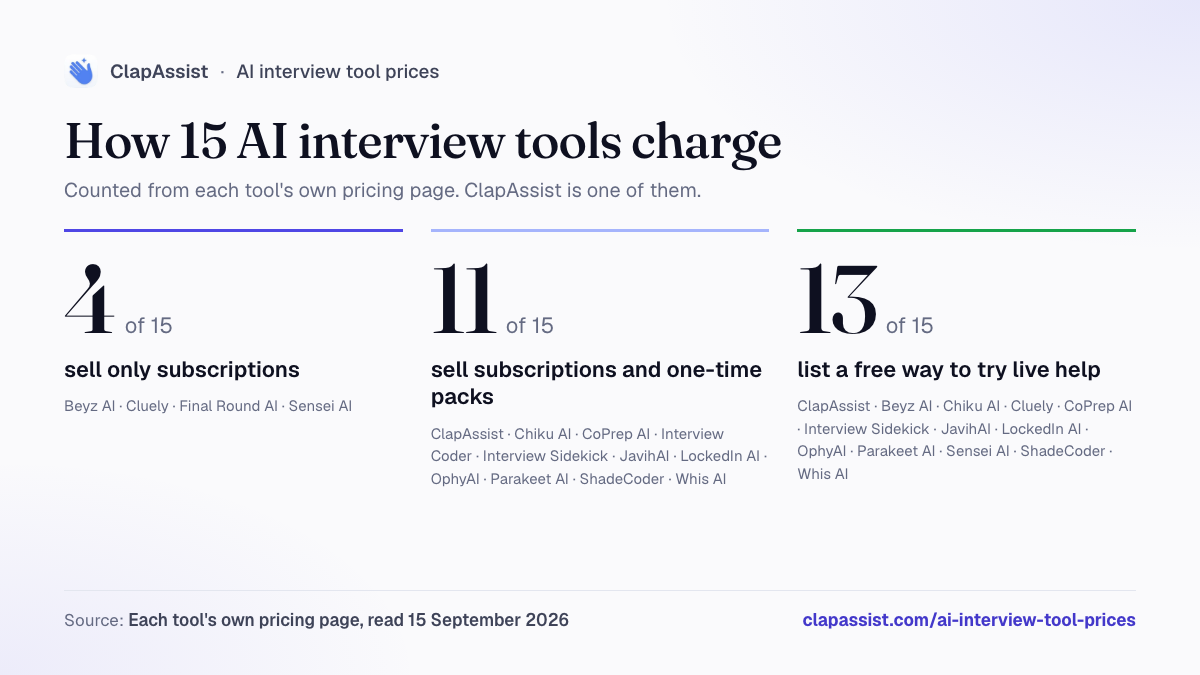
How 15 AI interview tools charge
Counted by us from each tool's own pricing page. The first two columns add up to all 15 tools; the last is counted on its own.
<a href="https://clapassist.com/ai-interview-tool-prices#chart-how-they-charge"><img src="https://clapassist.com/media/charts/ai-interview-tool-prices-2026-09-15-how-they-charge.png" alt="How 15 AI interview tools charge: 4 sell only subscriptions, 11 sell subscriptions and one-time packs, 13 list a free way to try live help. Read from each tool's own pricing page on 15 September 2026." width="1200" height="675" style="max-width:100%;height:auto" loading="lazy"></a>
<p>Chart: AI interview tool prices, read on 15 September 2026, by <a href="https://clapassist.com/ai-interview-tool-prices">ClapAssist</a> (CC BY 4.0)</p>The full table, the cost of one hour of live help and every plan with its source are on the price index, with CSV and JSON downloads.
Cards for your article, slides or post
Each card prints its figure and its source, so it stays correct wherever it travels. Download the picture, or copy the embed code and the credit link comes with it.
How this was made
- Only the organisation that measured it. Every figure links to the page of the survey, study or report itself, on the publisher's own website. Numbers found only on round-up pages, in blog posts or in other people's summaries were left out.
- Word for word. Next to each figure is the sentence it comes from, copied exactly. A script refuses to publish a figure that is not inside its own quote, or a claim that carries a number its source does not.
- Re-read on one date. Every source was opened again on 24 September 2026. Reports get updated; the date tells you which version this is.
- Different studies, different people. Each survey asked its own sample, in its own countries, in its own words. Figures from different sources are not added up or compared as if they were one study. The sample line under each figure says who was asked.
- Who paid for it. Several figures come from companies that sell hiring or careers products. That is noted where it applies, so you can weigh it.
- Who made this page. ClapAssist sells an AI interview assistant. We chose which figures to include, and we included the ones that cut against tools like ours.
Spotted an error or a newer number? Email support@clapassist.com with the link. Corrections go into a new dated edition, and the old one stays downloadable.
Cite and download
Every figure is in one file, with its quote, source link, publication date and sample: CSV · JSON. Our wording, the collection and the cards are free to reuse under CC BY 4.0 with a link to this page. Each number belongs to the organisation that measured it, so cite them too; the "Copy with source" button under every figure does both.
ClapAssist. (2026, September 24). AI in job interviews: the statistics. https://clapassist.com/ai-interview-statistics<a href="https://clapassist.com/ai-interview-statistics">AI in job interviews: the statistics</a> (ClapAssist, September 2026)